
Heritage Principles on the World Stage: the UNESCO World Heritage seminar in Korea

Updated: Sep 4
Dr James Lesh, Founding Director of Heritage Workshop, was invited to present at an international seminar held alongside the UNESCO World Heritage Committee meeting in Busan, South Korea in July 2026.
Hosted by the Korea Heritage Service, Hanyang University, and ICOMOS Korea, the event gathered international scholars and advisors to explore the Korean Principles for Conserving Values of Cultural Heritage (2022/2025).
The overarching theme for the two-day seminar was values-based conservation, which has long been at the core of Dr Lesh's research and heritage practice.

The Evolution of Value-Based Conservation
In his presentation, In Context: Korean Principles for Value-Based Heritage Conservation, Dr Lesh explored how modern conservation frameworks did not emerge in a vacuum; they carry the history of international policy shifts. The paper started with Alois Riegl’s 1903 recognition of artistic, age, commemorative, use, and newness values. While the 1964 Venice Charter focused primarily on physical monuments, Australia’s 1979 Burra Charter shifted global attention toward managing the overall cultural significance of heritage places.
Today, frameworks like the UNESCO Historic Urban Landscape (HUL) Recommendation reinforce that heritage is not a static object frozen in time, but an evolving social process that adapts alongside modern cities. Urban change and adaptive reuse are key mechanisms through which society keeps historic environments economically and socially viable.
Dr Lesh contextualised the new Korean policy framework within the broader trajectory of international conservation thought. This framing positioned the 2025 Korean Principles as an innovative heritage policy response, designed to address contemporary social, cultural, and environmental demands for the local context.

Key Innovations in the Korean Principles (2025)
The publication of the Korean Principles marks a significant contribution to international heritage frameworks. The document sets out clear operational guidelines across five stages: Investigation & Research, Assessment of Significance, Establishment of Plan, Implementation, and Monitoring & Management.
Several key policy innovations stand out:
Digital Integration (Articles 28 & 30): The principles formally incorporate multi-dimensional digital recording, standardised data management, and digital value communication.
Pragmatic Adaptive Reuse (Articles 25 & 26): By setting explicit parameters for "New Work" and "Use", the framework encourages functional adaptation so historic places remain active and economically sustainable without losing authentic fabric.
Chronological Humility (Article 5): The policy mandates minimal intervention and reversibility, acknowledging that future generations will have evolved scientific techniques and analytical methods.
Formalising Heritage Democracy (Article 6): The text explicitly defines the "heritage community" and foregrounds public accessibility, transparency, and participation in decision-making processes.
Like the Burra Charter (2013), it also identifies aesthetic, historic, scientific and social values, and provides a multi-step conservation process.

Returning from Korea to Australia
Gatherings like this seminar in Korea demonstrate that value-based conservation has become the global standard for heritage practice worldwide. It is a dynamic approach, which is still evolving to remain responsive to changing social, environmental, and economic priorities.
These international discussions also offer a pathway forward for inspiring innovative modes of heritage practice in Australia, including future iterations of our own values-based approach.
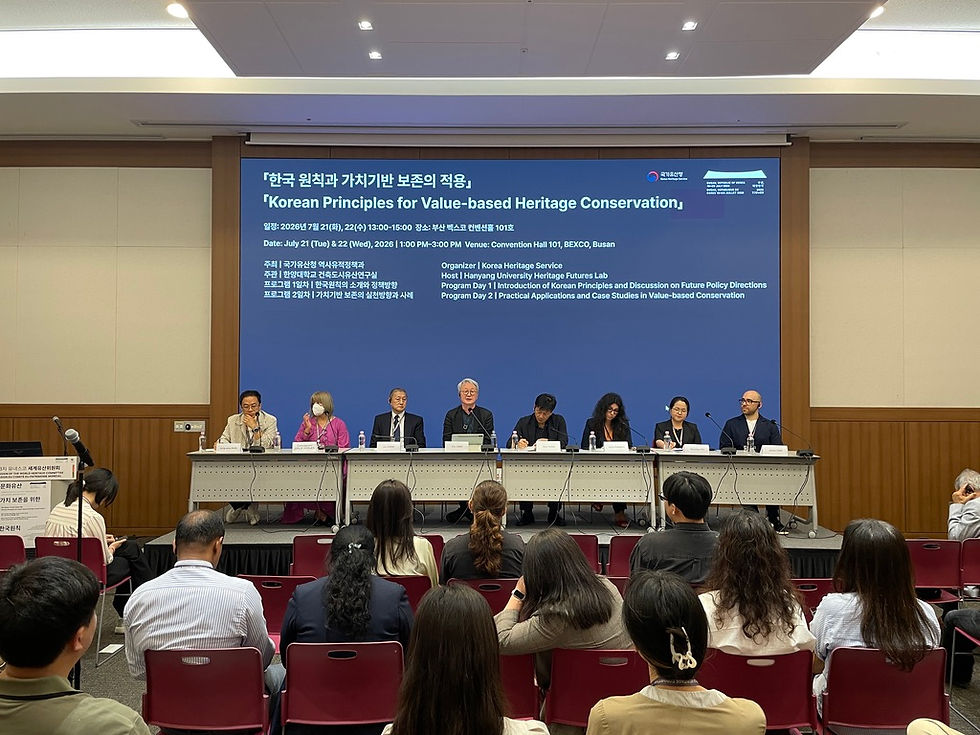
Disclosure: Dr James Lesh travelled to Busan courtesy of the Korea Heritage Service. Thanks to the Korea Heritage Service, Hanyang University, and ICOMOS Korea for their generous invitation, hosting, and support to participate in this two-day seminar as part of the 48th session of the UNESCO World Heritage Committee.
At Heritage Workshop, we apply global best-practice values-based conservation to Australian heritage places. Contact Dr James Lesh and the team at Heritage Workshop to discuss strategic policy advisory, heritage research, or municipal framework reviews.


